

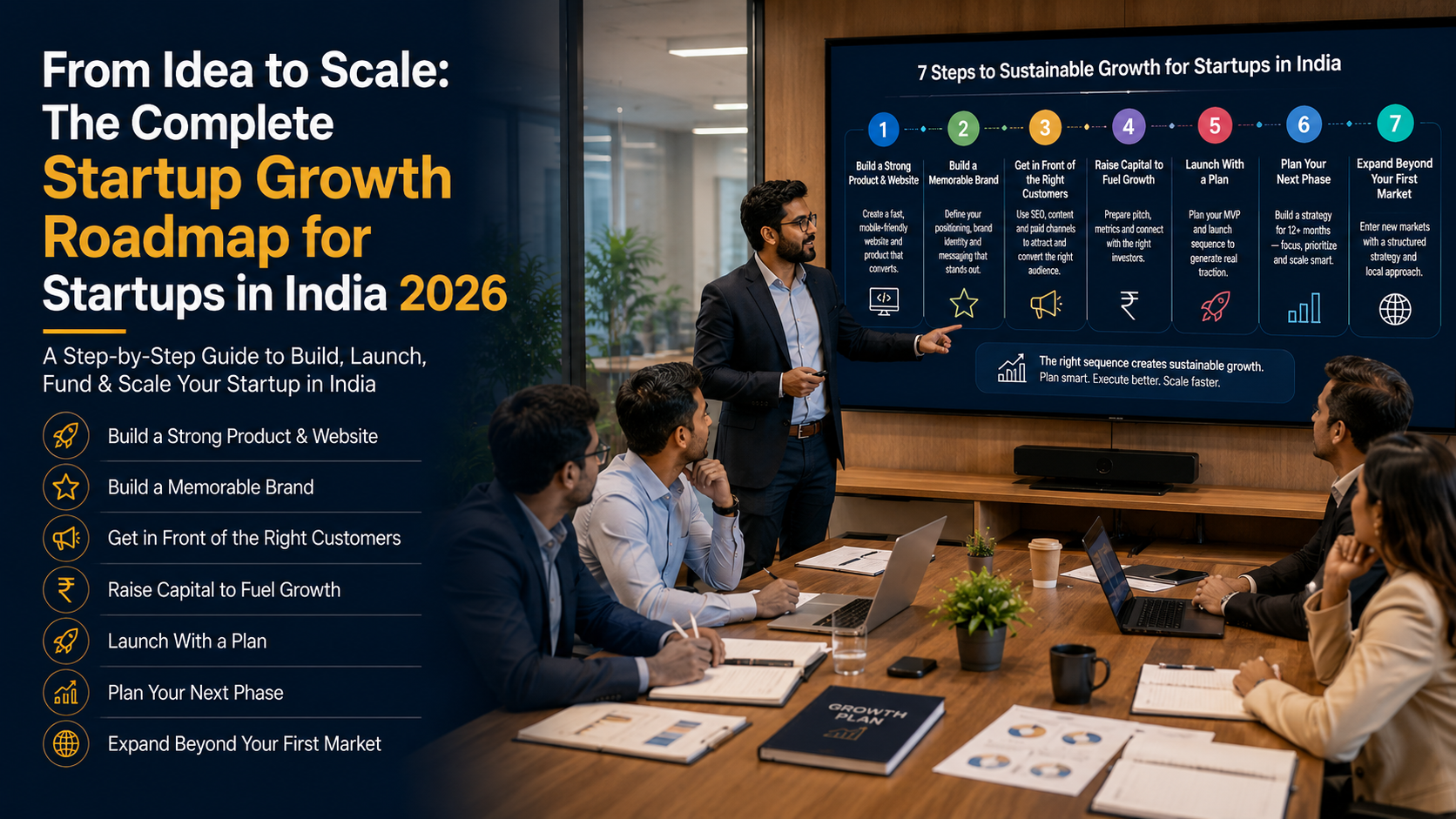
From Idea to Scale: The Complete Digital Growth Roadmap for Startups in India (2026)
Most Indian startups don't fail because the idea was weak. They fail because the founders solved problems in the wrong order — spending on paid ads before the website could convert, or chasing funding before the brand gave investors a reason to trust them. Growth isn't random. It follows a sequence. Here's what that sequence actually looks like in 2026, and what to get right at each stage.
Stage 1: Build a Product and Website That Can Actually Convert
Everything else you do — marketing, PR, fundraising — sends people to your website. If your website is slow, unprofessional or fails to provide the information you need in five seconds, each rupee you spend elsewhere is wasted. This is also the case for many founders in the early stages of their business failing to invest, seeing websites as mere formality, not the asset that runs the other aspects of the business.
Before anything else, get custom website development right — fast load times, mobile-first design (most of your Indian traffic will be on Android), and clear conversion paths. If you're also working on an app or require a larger technological infrastructure, a full-service IT solutions provider can manage this in tandem with your website and ensure that your website is not built on its own.
Stage 2: Shape a Brand People Actually Remember
A logo isn't a brand. Brand is the reason someone chooses you over three identical-sounding competitors in a crowded India-based startup market. Skipping this stage is why so many startups end up sounding like every other company in their category — same blue-and-white palette, same 'innovative solutions' copy, nothing that sticks.
This is where brand consulting services pay off early rather than late. Positioning, messaging, and visual identity done before you scale marketing spend means every rupee of ad spend reinforces the same story, instead of building a brand from scratch after you've already burned the budget on generic campaigns.
Stage 3: Get in Front of the Right Customers
After the product and the brand are able to stand on their own, the next challenge is visibility. Many founders jump right into paid advertising because it seems most efficient, however without SEO and content operating in tandem, every penny of paid traffic is stopped the time the budget gets there.
A well-planned digital marketing strategy combines SEO as well as content and paid channels, so you don't have to rebuild your visibility every month from scratch. In the case of an India market it is also important to account for regional-specific language search behaviour as well as mobile-first user-centric journeys not simply running the same game plan that is used across either the US as well as the UK.
Stage 4: Raise the Capital to Fuel the Next Phase
Growth costs money before it makes money. Whether it's a pre-seed round to extend runway or a Series A to scale hiring, most first-time founders underestimate how much of fundraising is preparation — a sharp pitch deck, defensible metrics, and knowing which investors actually fund your sector and stage.
This is where startup funding advisory makes the difference between a founder cold-emailing fifty investors and one walking into the right ten conversations already prepared.
Stage 5: Launch With a Plan, Not a Guess
There's a real difference between 'we shipped something' and a launch that's actually built to generate signal — early users, press, and word of mouth that compounds instead of a one-day spike that disappears by Friday.
Structuring this properly is what project launch support is built for — from MVP scoping to a launch sequence that gets your first hundred users talking, not just your first hundred downloads.
Stage 6: Build a Strategy for What Comes After Launch
Launch day energy fades fast. What separates startups that keep growing from ones that plateau at month six is whether there's an actual strategy behind the next phase — or just more of the same tactics repeated louder.
This is the point to bring in business strategy planning — figuring out what to double down on, what to cut, and how the next 12 months should actually be sequenced, rather than reacting quarter to quarter.
Stage 7: Expand Beyond Your First Market
Once a startup has traction in one city or one segment, the temptation is to expand everywhere at once. That's usually a mistake. Markets like Delhi, Bangalore, and Mumbai each behave differently, and expanding without a plan burns cash fast.
A structured business expansion strategy — sequencing which market to enter next, and what needs to change locally — is what turns early traction into a company that actually scales across India, instead of one that stalls after its first city.
The Sequence Matters More Than the Speed
None of these stages work well in isolation. A great product with no brand looks generic. A great brand with no marketing stays invisible. Funding without a strategy just means burning cash faster. The companies that are able to sustain their growth in India's market 2026 are those that approach this as a sequential process rather than a checklist to be tackled in a random order.