

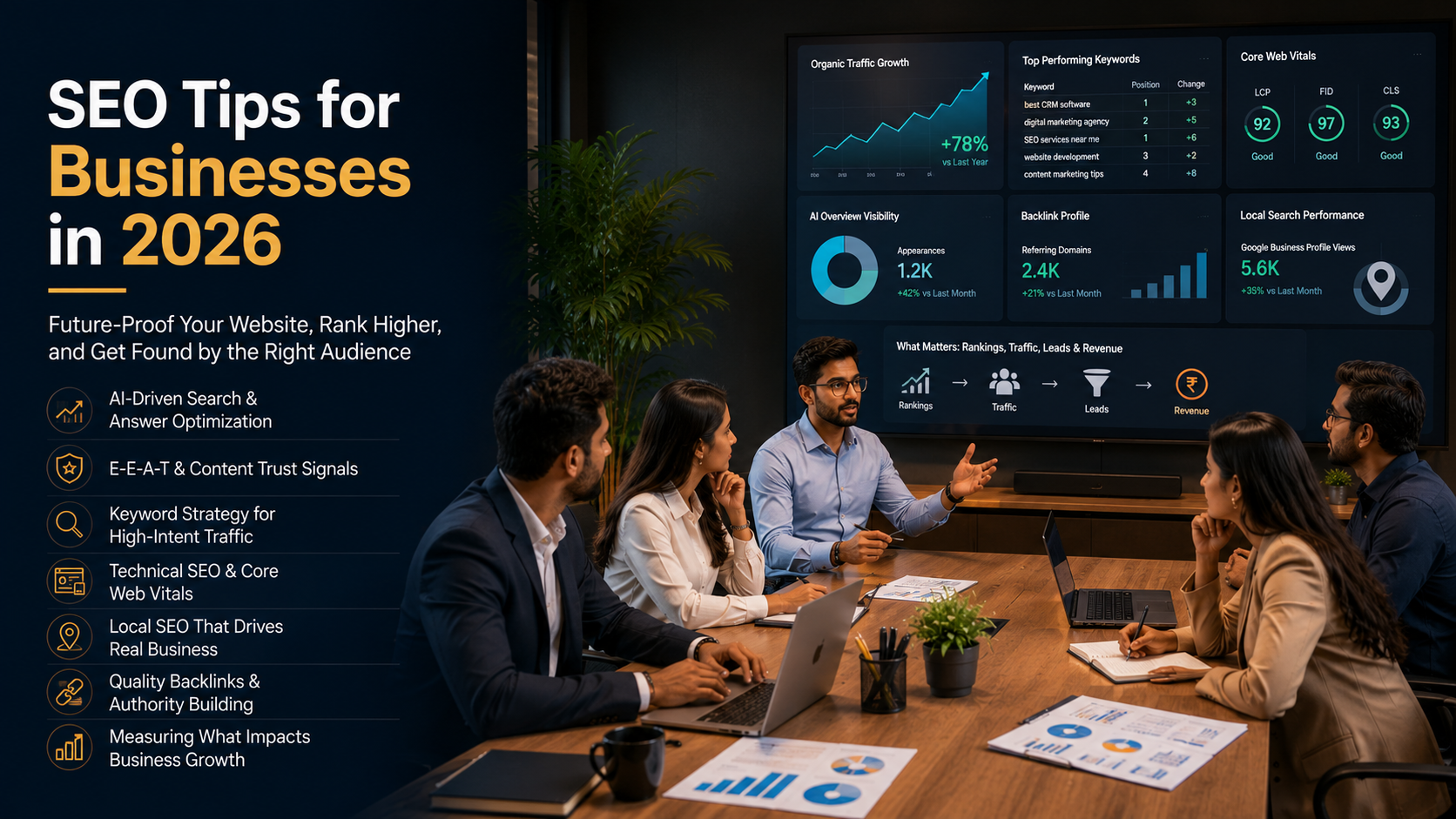
Why SEO Still Works - Just Differently
About half of all web traffic comes via organic search. What's changed is the location instead of 10 blue links users are increasingly seeing an answer that is synthesized usually taken from a few reliable sources. Ranking on page one used to be the finish line. Now, being the source that AI tools cite is the new finish line — and it runs through the same fundamentals of relevance, structure, and trust, just applied more rigorously.
1. Build Content Around E-E-A-T, Not Just Keywords
E-E A-T- Experience, Expertise and Authoritativeness, as well as Credibility -- has been the predominant rating framework and is not an additional factor. In real life this is:
- —Experience: Show you've completed the task the article is about and not simply conducted research. Actual facts, first-hand details and concrete examples beat general suggestions.
- —Expertise: The author has bylines based on authentic credentials Not 'Admin' as well as 'Team.'
- —Authoritativeness: Other reliable websites and references to you.
- —Trustworthiness: Up-to-date, accurate information, transparent source, secure website (HTTPS) and clear details about your business.
It's not like the content was created to meet a quota for keywords instead of to help a particular person. It is precisely the kind of content that both AI and user systems are taught to ignore.
2. Structure Content So AI Can Extract It
AI Overviews and answer engines scan pages for content they can lift cleanly and cite. That means:
- —Answer the question in the first 1–2 sentences under each heading, then elaborate below. Don't bury the direct answer three paragraphs in.
- —Use real headings that match how people actually search — 'How much does X cost' instead of a vague heading like 'Pricing Information.'
- —Use numbered lists, tables, and FAQs wherever the content is inherently list-like or comparative — these formats get pulled into AI summaries far more often than dense paragraphs.
- —Mark up content with schema (FAQPage Article LocalBusiness, Product when appropriate) so that computers aren't forced to guess the structure.
It's sometimes referred to as'Answer Engine Optimization (AEO) -It's not a distinct area of SEO but it's SEO used to create a page of search results that includes AI-generated responses.
3. Get the Technical Foundation Right
The content on the site is not what does any good if the site itself causes friction. The 2026 technical baseline
- —The Core Web Vitals - loading speed, interactivity as well as visual stability play directly in rankings.
- —Mobile-first performance - Google examines and indexes its mobile-friendly version of your website by default.
- —Clean crawlability — a submitted XML sitemap, a correctly configured robots.txt, and no orphaned pages.
- —HTTPS — table stakes at this point, both for ranking and for user trust.
If a user clicks through from an AI Overview and the page takes five seconds to load, that click doesn't convert — and repeated friction like that quietly erodes how much search engines trust the site.
4. Match Content to Search Intent, Not Just Search Volume
Two searches can look similar in volume but mean very different things. Someone searching 'web development company near me' is ready to talk to someone. Someone searching 'how much does a website cost in India' is still researching. Both deserve content — but they need different content, connected to each other:
- —Informational content (guides, explainers) builds trust and captures early-stage searchers.
- —Commercial/transactional content (service pages) converts searchers who are ready to act.
- —The link between them matters — informational content that never points toward a clear next step wastes the traffic it earns.
5. Treat Local SEO as Non-Negotiable (Especially for India-Based Businesses)
For any business serving specific cities or regions, local signals now carry outsized weight:
- —A fully completed Google Business Profile, updated regularly with posts and accurate hours
- —Consistent business name, address, and phone number across every directory listing
- —Active review management — responding to every review, not just the positive ones
- —Local-specific content that shows the way that people living in that region or city search and use the internet, including regional patterns of language in the event that they are relevant.
Local relevance signals are among the very few areas of SEO where smaller companies can succeed with the speed and consistency of their efforts, without being in competition with international or national players.
6. Build Authority Through Real Link Building, Not Shortcuts
Quality has fully overtaken quantity in how link building is evaluated:
- —Earned mentions from credible, relevant sources in your niche
- —Genuine guest content on sites your actual audience reads
- —Converting unlinked brand mentions into linked ones
- —Avoiding purchased links or spammy directory submissions, which now carry real penalty risk rather than just diminishing returns
One relevant, earned link from a trusted source in your industry is worth more than dozens of low-quality directory links.
7. Measure What Actually Reflects Business Health
Traffic and rankings are easy to track and easy to be misled by. A 50% traffic increase means little if none of it converts. Track instead:
- —Which keywords are driving qualified leads, not just impressions
- —Where in the funnel visitors are dropping off
- —Whether informational content is successfully guiding readers toward commercial pages
- —Search Console data on a monthly cadence, at minimum, to catch ranking or indexing issues early
SEO that only moves a traffic dashboard, without moving revenue, is a sign the content-to-conversion path needs fixing — not necessarily a sign SEO isn't working.
Quick-Reference Action Checklist
- —Every page answers its core question in the first 1–2 sentences under the relevant heading
- —FAQ and Article schema implemented on key pages
- —Core Web Vitals checked and fixed (PageSpeed Insights or similar)
- —Google Business Profile fully completed and updated monthly (if location-based)
- —Author bylines with real credentials on all published content
- —Informational content links clearly toward relevant commercial pages
- —Backlink strategy reviewed for quality over volume
- —Search Console reviewed monthly for indexing and ranking issues
Where Markifid Fits In
Executing all of this consistently — content, technical, local, and measurement — is exactly where most businesses run out of time before they run out of ideas. If you'd rather have a team handle the strategy and execution end-to-end, you can see how Markifid approaches digital growth on the marketing hub.