
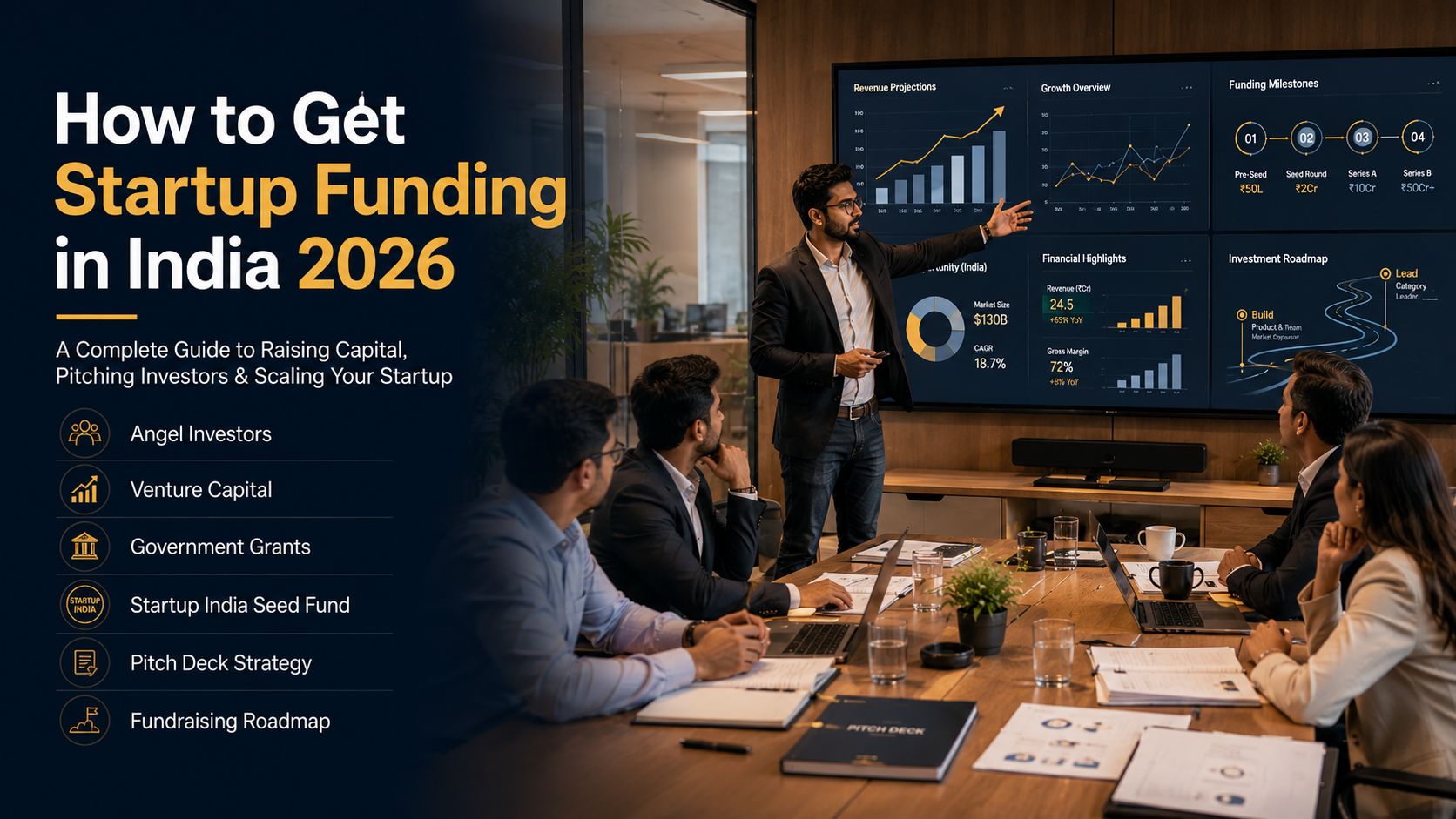
The State of Startup Funding in India in 2026
India is the third-largest startup ecosystem globally by startup count. But the funding environment has tightened significantly since the 2021 boom.
In 2026, investors want founders who:
- —Demonstrate capital efficiency — doing more with less
- —Show clear unit economics — not just revenue, but margins and costs
- —Have honest self-awareness — understanding their gaps, not just their strengths
- —Present a credible path to profitability — not a perpetual growth story
The good news: India's startup ecosystem is more mature than ever, with more funding sources, more angel networks, and more government support than at any previous point.
Explore Markifid's startup funding advisory →
Understanding Startup Funding Stages
Before you approach any investor, you need to understand which stage your startup is at — because different stages attract different investors and require different materials.
Pre-Seed Stage
What it means: You have an idea, an early team, and possibly an MVP or prototype. No significant revenue yet.
Typical raise: ₹25L – ₹2Cr
Right investors: Friends and family, angel investors, micro-VCs, government grants
What you need:
- —A clear problem-solution narrative
- —An early financial model
- —A pitch deck that makes angels believe in you before the numbers can
Seed Stage
What it means: You have early traction — users, revenue, or clear product-market fit signals. You need capital to grow the team and prove the model at scale.
Typical raise: ₹1Cr – ₹10Cr
Right investors: Angel networks (Indian Angel Network, Mumbai Angels), seed-stage VCs
What you need:
- —Traction metrics (users, revenue, retention)
- —Unit economics story (CAC, LTV, margins)
- —A credible GTM plan
- —A pitch deck showing exactly what you will do with the money
Series A / Venture Capital
What it means: You have proven the model and need institutional capital to scale aggressively.
Typical raise: ₹10Cr – ₹100Cr+
Right investors: Venture capital firms — Peak XV Partners (formerly Sequoia India), Accel, Blume Ventures, Nexus Venture Partners
What you need:
- —Strong revenue visibility
- —Clear and defensible unit economics
- —A scalable operational model
- —Institutional-grade due diligence readiness
6 Ways to Fund Your Startup in India
1. Bootstrapping
The startup can be funded with your savings or from early revenues without having to give up equity.
Best for: startups that have low capital requirements for their initial investment or founders who wish to keep full ownership.
Pros: There is no equity diluting. Full control enforces financial discipline.
Cons: Growth is limited by personal capital; it is harder to grow quickly.
2. Friends and Family
Raising early capital from people who know and trust you personally.
Best for: Very early pre-seed stage before you have enough traction for angel investors.
Key consideration: Always document this capital formally — even from family. An undocumented cap table creates problems at every future funding round.
3. Angel Investors
Angel investors are high-net-worth individuals who invest their own money into early-stage startups in exchange for equity.
In India, prominent angel networks include:
- —Indian Angel Network (IAN)
- —Mumbai Angels
- —Lead Angels
- —Chennai Angels
In 2026, entrepreneurs need a track record of successful execution and a clearly-articulated plan for going to market to get angel investors. Angel rounds are best when you have a clearly defined 18-month timeframe for your milestones that will indicate when the funding will be next, not just an introductory deck.
How to approach angel investors:
- —Use warm introductions through founders, mentors, or accelerator networks
- —Target angels who have invested in similar sectors or business models
- —Be specific and grounded in traction — not just vision
4. Government Schemes and Grants
India has several government funding programmes specifically for startups — many of which are non-dilutive (you do not give up equity).
Key schemes in 2026:
Startup India Seed Fund Scheme (SISFS): Provides up to ₹20L as a grant and ₹50L as convertible debt for DPIIT-registered startups at the pre-seed stage. Applied through empanelled incubators.
SIDBI Fund of Funds: SIDBI allocates capital to SEBI-registered AIF venture funds that then invest in startups — an indirect route through VC funds that have received SIDBI allocation.
State Government Schemes: Many state governments (Rajasthan, Karnataka, Maharashtra, Telangana) have their own startup grants, soft loans, and incentive programmes. Check your specific state's startup policy for current offerings.
5. Accelerator Programmes
Accelerators provide a combination of equity capital, mentoring, network access, and investor introductions — in exchange for 2% to 8% equity or a fixed fee.
Prominent accelerators in India in 2026:
- —Y Combinator (India cohorts)
- —Antler India
- —Sequoia Surge
- —100x Entrepreneur
- —CIIE.CO at IIM Ahmedabad
Accelerators are particularly valuable for first-time founders who need both capital and the structured support of a programme to reach their next milestone.
6. Venture Capital
Venture capital becomes relevant after a startup has demonstrated product-market fit and needs institutional capital to scale.
VC funding is not for every startup. It is right for startups that:
- —Have a large addressable market
- —Can demonstrate rapid scalability
- —Are building for a significant exit — IPO or acquisition
Explore Markifid's funding advisory services →
What Indian Investors Look for in 2026
The fundraising environment has changed significantly from 2021. Here is what investors are actually evaluating right now:
1. Unit Economics
Investors want to see your contribution margins, customer acquisition cost (CAC), lifetime value (LTV), and a clear path to profitability — before they care about revenue scale.
2. Founder Credibility
Domain expertise, execution history, and the ability to answer hard questions under pressure are now table stakes at every stage. Investors are betting on the founder as much as the business.
3. Clean Governance
A clean cap table, proper DPIIT registration, compliance with company law, and structured financial reporting signal a business that will survive due diligence without creating legal problems post-investment.
4. Market Defensibility
Why will you win? A clear moat — technology, distribution, network effects, or brand — is increasingly required even at seed stage. A large market alone is no longer enough.
5. Revenue Visibility
ARR, cohort retention, and net revenue retention are the metrics being scrutinised. Investors want predictable revenue — not a pipeline that looks promising but has not converted.
How to Build a Pitch Deck That Works
Your pitch deck is the most important document in your fundraising process. A weak deck is the most common reason qualified startups get rejected before the first meeting.
A strong pitch deck covers:
- —Problem — what is broken and for whom
- —Solution — how you solve it
- —Market size — total addressable market, realistic target
- —Product — what you have built and what it does
- —Traction — users, revenue, growth rate, retention
- —Business model — how you make money
- —Go-to-market — how you acquire customers
- —Team — why you are the right people to build this
- —Financials — 18–24 month projections with clear assumptions
- —The ask — how much you are raising and what you will use it for
Every slide should be clear enough to understand in 30 seconds. Investors see hundreds of decks — clarity wins every time.
Markifid's funding advisory covers pitch decks and financial modelling →
How to Approach Investors in India
- Warm introductions work best — a pitch from a mutual connection is 4x more likely to get a response than a cold email. Build your network before you need it.
- Target the right investors — research which investors have backed companies in your sector and stage.
- Personalise your outreach — reference specific investments they have made. Generic outreach gets ignored.
- Follow up consistently — fundraising takes 3 to 9 months. Most investors say no initially and yes later — after you have hit the milestone they were waiting for.
Common Fundraising Mistakes Indian Founders Make
- —Raising too early — approaching investors before you have enough traction to tell a compelling story.
- —Raising too much or too little — the ask should match 18 to 24 months of runway at your current burn rate.
- —Ignoring legal and governance basics — a messy cap table or non-compliant company structure kills deals at due diligence stage.
- —Not preparing for hard questions — investors will ask about your churn rate, your biggest competitor, and what happens if your main assumption is wrong. Prepare honest answers.